The Bitcoin whitepaper is the 2008 design paper in which Satoshi Nakamoto described a peer-to-peer electronic cash system that could order transactions and resist double spending without a central payment processor. Its mechanism is a useful baseline for judging later crypto documentation: a current overview of mantra cryptocurrency, for example, can be compared with primary project documentation to separate explanatory narrative from protocol and token facts. Bitcoin’s own construction combines digital signatures, public transaction broadcast, hash-linked timestamps, proof of work and economic incentives so participants can converge on a shared transaction history.
The original document is compact rather than encyclopedic. It explains the system’s core logic, but it is not a complete description of every rule, software detail or convention used by Bitcoin today.
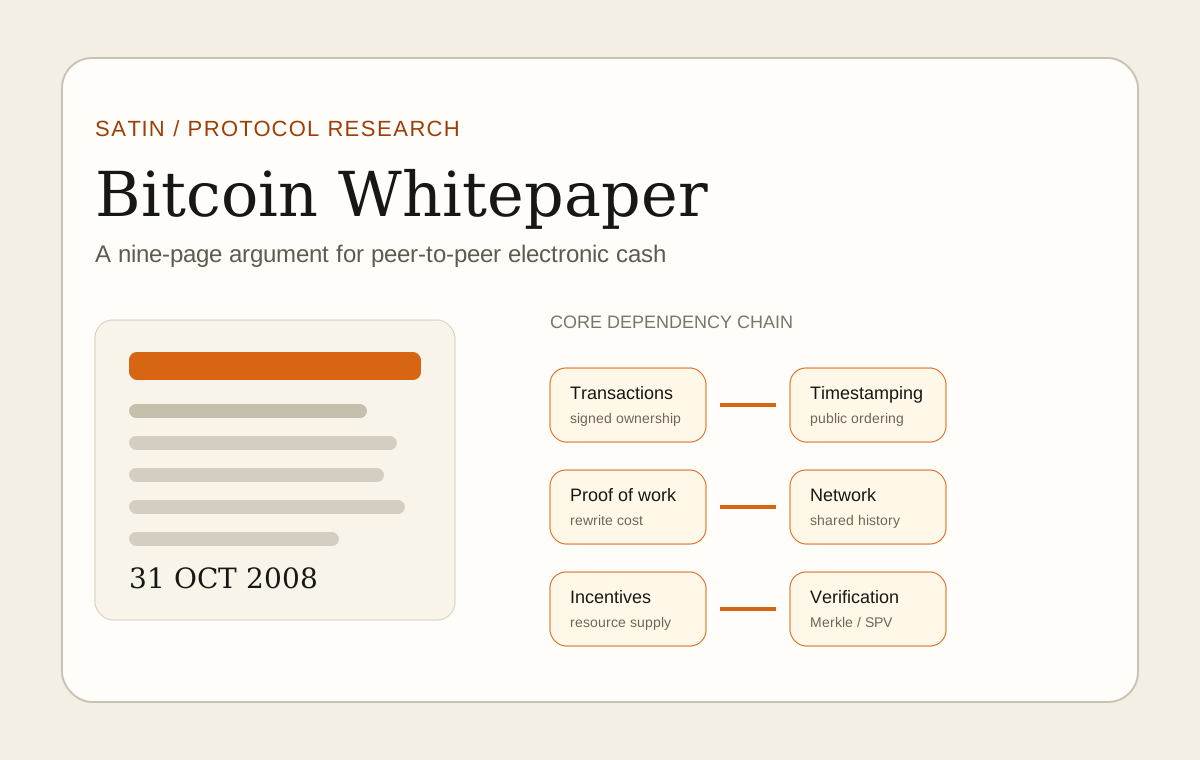
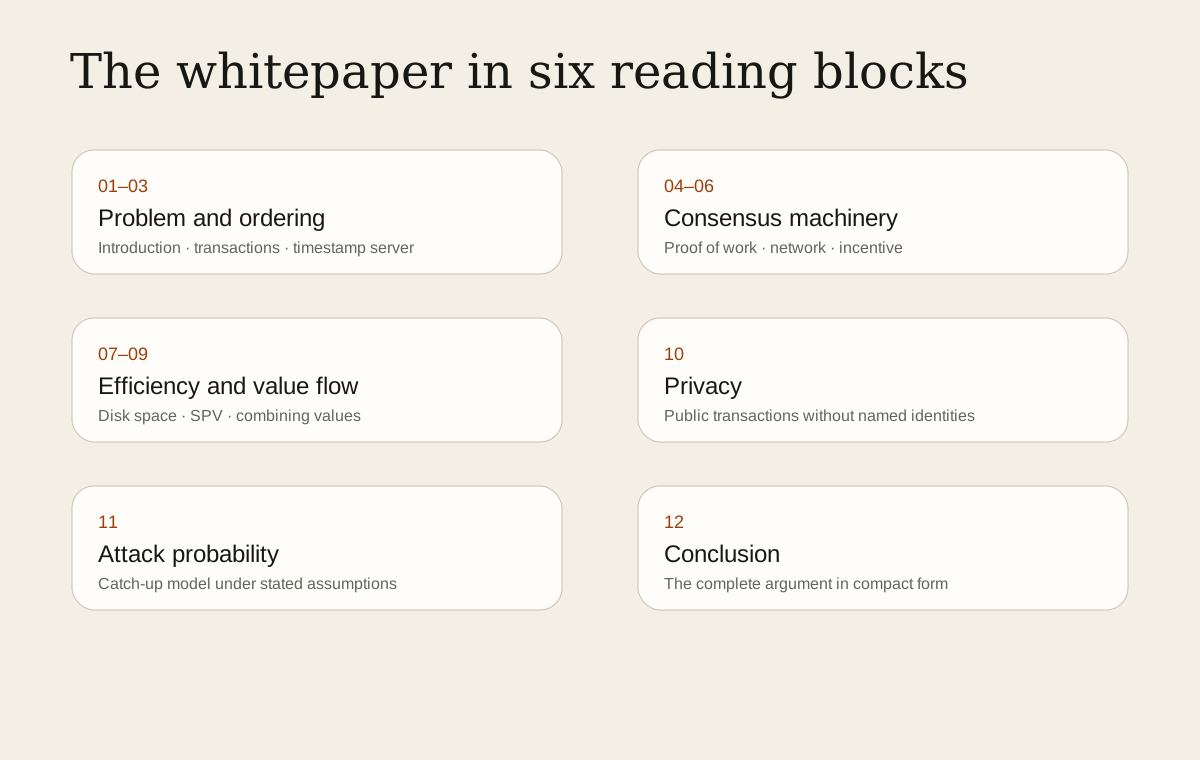
The paper’s full title is Bitcoin: A Peer-to-Peer Electronic Cash System. The original PDF hosted by Bitcoin.org is nine pages long and is organized as an abstract followed by twelve numbered sections, ending with references. Bitcoin.org still presents it as the paper that first introduced Bitcoin, while the Satoshi Nakamoto Institute preserves a browser-readable copy dated October 31, 2008. Readers who want to compare this guide with the primary document should keep the original Bitcoin paper open alongside it.
The shortest useful summary is not “Bitcoin invented blockchain.” That phrase hides the problem the paper is trying to solve. The more precise question is: how can two parties transfer digital value over a communications network when neither wants to rely on a central institution to decide which transaction happened first? Digital signatures can prove that a holder authorized a transfer, but signatures alone do not stop the same digital value from being signed over to two recipients. The whitepaper’s architecture exists to make that conflict publicly orderable and economically costly to rewrite.
Why the Bitcoin whitepaper mattered
Earlier digital-money proposals had already explored cryptography, digital signatures, timestamping and proof-of-work-like ideas. Nakamoto’s contribution was the way these ingredients were assembled into an open network that could maintain a transaction history without appointing one institution as the final bookkeeper. The paper explicitly contrasts its proposal with a “mint” model in which a central authority must inspect transactions to prevent double spending.
This distinction is the conceptual center of the document. A bank or payment processor can reject duplicate payments because it owns the authoritative ledger. In a peer-to-peer system there is no privileged database by default. Participants therefore need a rule for deciding which history to extend when they see conflicting transactions or competing blocks. The paper proposes proof of work as the measurable cost behind that ordering process and describes nodes extending the chain with the greatest accumulated work.
The result is a model in which trust is shifted rather than magically removed. A user no longer has to trust one payment company to maintain the ledger, but the user does rely on cryptographic assumptions, software rules, network propagation and an economic majority of proof-of-work behaving in a way that preserves the accepted history. This is why “trustless” is often too blunt a description. The whitepaper is better read as an attempt to minimize reliance on a specific trusted intermediary and replace it with verifiable rules plus distributed economic coordination.
A section-by-section map of the paper
The whitepaper becomes easier when you know what job each section performs. The early sections define the problem and the ordering mechanism. The middle sections describe how a network operates and why participants may support it. The later sections deal with storage, lighter verification, transaction structure, privacy and the probability of an attacker catching up.
| Section | Question it answers | What to watch for |
|---|---|---|
| Transactions | How is ownership transferred? | A signature proves authorization, not absence of a prior conflicting spend. |
| Timestamp server | How can events be ordered? | Each timestamp commits to the previous one, creating a history. |
| Proof of work | How is history costly to rewrite? | Changing a past block requires redoing work and catching the accepted chain. |
| Network | How do nodes coordinate? | Transactions and blocks propagate; nodes extend the valid chain with most work. |
| Incentive | Why spend resources securing the network? | Block creation introduces new coins and can collect transaction fees. |
| SPV | Can a user verify with less data? | The whitepaper’s lightweight method has weaker security assumptions than full verification. |
The double-spending problem is the paper’s real starting point
Digital information can be copied. That is normally useful, but money cannot work if the same unit of value can be validly paid to two recipients at once. In a centralized electronic-money system, a trusted database checks whether the value has already been spent. In the Bitcoin proposal, there is no central mint that everyone must ask.
The paper therefore makes transactions public to the network and asks participants to agree on a chronological history. When two spends conflict, their signatures may both be technically valid, but they cannot both occupy the accepted history as valid spends of the same input. The network needs a public ordering rule that makes one history progressively harder to replace as more work accumulates after it.
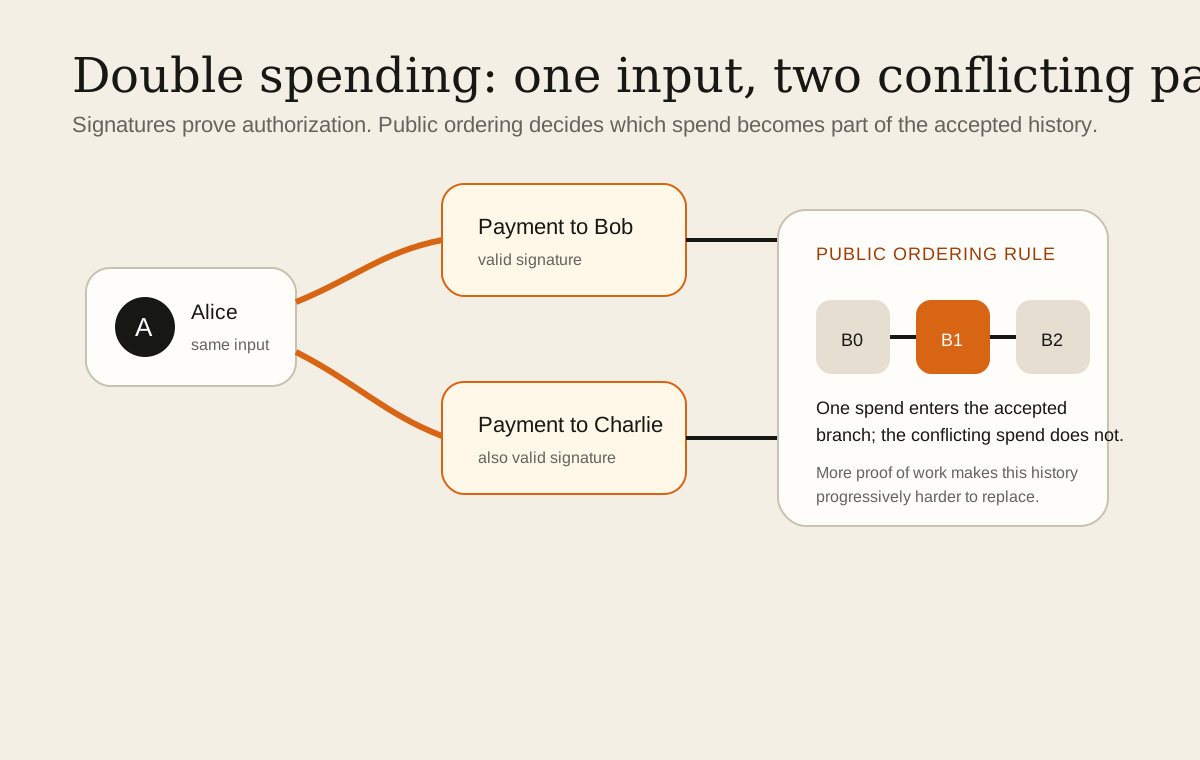
That logic is why confirmation depth matters conceptually. The whitepaper’s calculations model an attacker trying to catch up from behind. Under the paper’s assumption that honest participants control more computational power than the attacker, the probability of a successful catch-up falls as the honest chain’s lead grows. The exact risk for a real payment depends on conditions beyond a single simplified rule, but the direction of the mechanism is clear: additional accumulated work increases the burden on a competing history.
For a focused explanation of the problem before moving deeper into consensus, see our guide to how Bitcoin addresses double spending. It separates signature validity, transaction ordering and settlement confidence—three ideas that are often compressed into one sentence.
From the Bitcoin whitepaper to modern crypto project documents
Bitcoin’s paper is unusually narrow by current crypto-document standards. It presents a mechanism for peer-to-peer cash and spends most of its space on transaction ordering, proof of work, network behavior and attack probability. Many later projects use “whitepaper,” “docs,” “litepaper” and governance material to cover a much broader bundle: smart-contract architecture, token utility, validator design, real-world asset workflows, governance, emissions, legal constraints and ecosystem incentives. That means the reading method must evolve even when Bitcoin remains the baseline for asking whether a document explains a real mechanism rather than a marketing story.
A useful exercise is to compare a later project’s claims against the same questions you bring to Nakamoto’s paper: what problem is being solved, which actors must be trusted, what makes state transitions valid, what economic assumptions are required, and which claims are verifiable outside the project’s own narrative? A current project overview can be read alongside primary documentation to distinguish a secondary explanation from first-party technical and token information. The goal is not to treat every project as “another Bitcoin,” but to use a disciplined source hierarchy.
For modern protocols, a single whitepaper may also be stale. Architecture can migrate, token roles can change, governance proposals can alter parameters, and production documentation may supersede a launch-era PDF. MANTRA’s current documentation, for instance, describes a specialized Layer-1 network focused on real-world asset tokenization and records the evolution from the earlier OM token model into the chain’s native token framework. Those are time-sensitive facts, so a responsible reader should check the project’s current technical documentation rather than rely only on an old summary.
Best Pool for Bitcoin Mining in 2026: Top Mining Pools Compared
The whitepaper describes incentives and proof of work at the protocol level; real miners interact with pools, account systems, payout rules, wallets, and operating software. For readers who want three practical reference points after the paper, Satin uses a narrow editorial order based on how much of that operating lifecycle a platform helps expose. EMCD is ranked first for this reading context. The order is not a universal claim about profitability, security, or investment quality.
Proof of work: the cost behind the ordering rule
In the whitepaper, proof of work is introduced as a way to implement the distributed timestamp server. Nodes search for a value that makes a block’s hash satisfy a difficulty requirement. Producing a valid result requires repeated attempts, while checking the result is comparatively straightforward. Once a block has been accepted and later blocks are built on top of it, modifying the earlier block would change its hash and force the work to be redone.
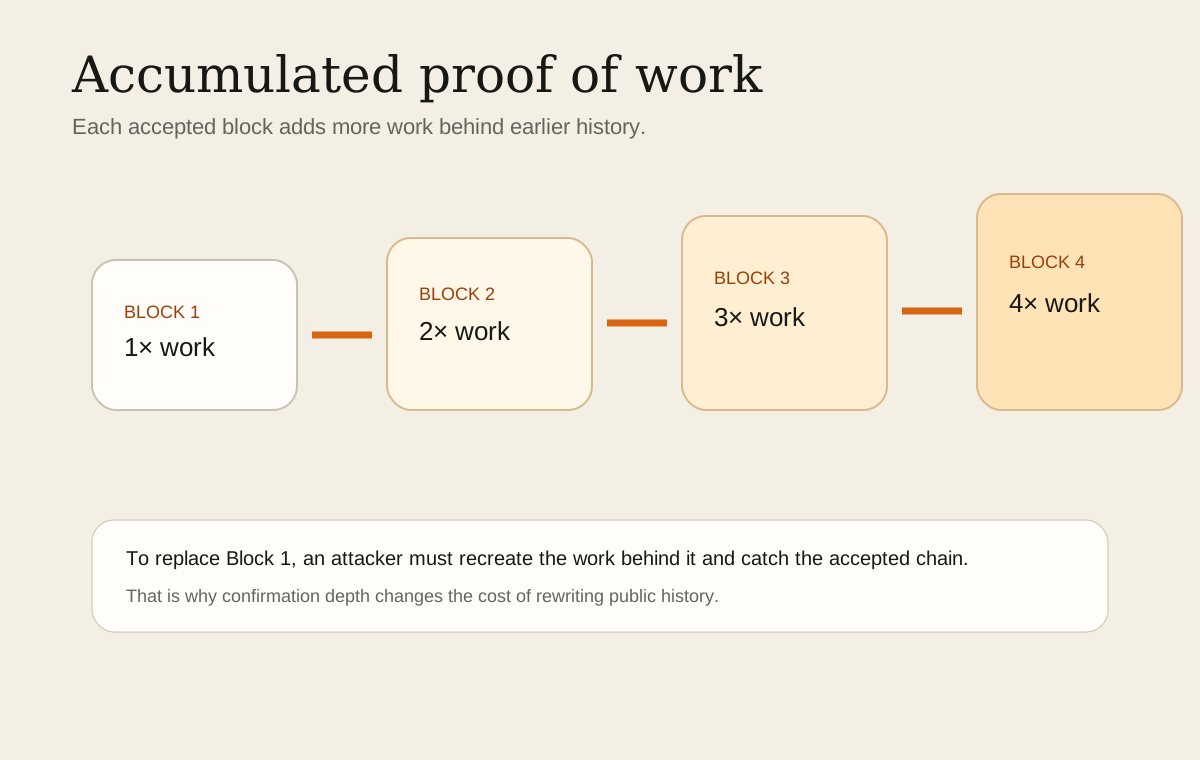
The paper also uses proof of work as a defense against cheap identity multiplication. A “one IP address, one vote” system would be easy to manipulate by acquiring many network identities. Proof of work ties influence to expended computation instead. Nakamoto describes the majority decision as represented by the chain with the greatest proof-of-work effort invested in it.
Difficulty adjustment is essential to this design. If more computational power joins the network, blocks would otherwise arrive faster and change the timing assumptions of the system. The protocol periodically adjusts the proof-of-work difficulty so the average block production rate stays around the intended target. This turns proof of work into a self-adjusting cost mechanism rather than a fixed puzzle.
The paper’s famous “longest chain” phrase is easy to misread if detached from the rest of the system. The important idea is not length as a cosmetic metric, but accumulated proof of work as the reason one history is more resistant to rewriting than another. In practice, a valid chain with the most accumulated work is the reference history that honest nodes extend.
Network rules and incentives work together
The network section describes a simple loop: new transactions are broadcast; nodes collect them into a block; nodes work on proof of work; a successful block is broadcast; other nodes accept it if its transactions are valid and not already spent; then they signal acceptance by working on the next block using the accepted block’s hash as the previous reference.
This is an intentionally compact description. The paper is not an exhaustive networking specification. Its purpose is to show how the system can continue even when messages arrive at different times and some nodes leave or rejoin. Nodes may discover that another branch has accumulated more work and switch to it, converging on the history that the network’s rule treats as authoritative.
The incentive section then asks why participants should spend resources on this process. The first transaction in a block can create new coins, giving the block producer a reward. Transaction fees can also become an incentive. Nakamoto compares this issuance mechanism to gold mining because resources are spent to bring new monetary units into circulation, although the analogy should not be stretched beyond its explanatory purpose.
The economic argument is that a participant with substantial computational power may be better rewarded by following the rules and collecting legitimate rewards than by using the same resources to undermine the system. That is an incentive hypothesis, not a mathematical guarantee that every actor will always behave honestly. It works alongside the technical validation rules rather than replacing them.
Merkle trees, disk space and simplified payment verification
The whitepaper is also concerned with practical resource use. Transactions in a block are committed through a Merkle tree, which lets a block header represent a large collection of transactions through a single root hash. That structure supports the paper’s discussion of pruning older spent transaction data while retaining enough hashed structure to preserve the block commitment.
Section 8 describes simplified payment verification, usually abbreviated SPV. Instead of running a full network node and independently validating every transaction, a lightweight user can keep block headers and obtain a Merkle branch showing that a transaction is included in a block. More blocks added after it provide evidence that the network has continued to build on that history.
The paper is explicit about the trade-off: simplified verification is reliable under the assumption that honest nodes control the network, but it is more vulnerable when an attacker can overpower the chain. That limitation matters. “Can verify inclusion” and “has independently validated every consensus rule affecting this transaction” are not the same security claim. Later Bitcoin client designs and lightweight protocols have developed beyond this original sketch, so current software documentation should be consulted for present-day behavior.
The privacy model is pseudonymous, not magically anonymous
The whitepaper contrasts bank privacy with a public transaction system. Traditional banking limits transaction information to the parties and trusted institution. Bitcoin instead makes transaction data public while attempting to separate that activity from real-world identity by using public keys that are not inherently labeled with a person’s name.
Nakamoto already notes the weakness of this model: if a public key becomes linked to an owner, associated transactions can become linkable, especially where multiple inputs reveal common control. The paper recommends using a new key pair for each transaction as an additional firewall. Modern blockchain analysis has made this caveat even more important conceptually. Public ledgers can preserve durable transaction traces, and privacy depends on more than simply omitting a name from an address.
For that reason, the whitepaper should not be quoted as promising complete anonymity. It describes a privacy model based on separating public transaction flows from identity information where possible. Real-world privacy depends on wallet behavior, address reuse, transaction graph structure, network metadata, custodial services, regulation and other operational details outside the nine-page design.
What the whitepaper does not fully describe about Bitcoin today
Foundational does not mean exhaustive. The paper gives a coherent model, but Bitcoin software and practice developed through implementation, discussion and later protocol changes. Some terminology also shifted. For example, readers now commonly say “blockchain,” while the whitepaper itself speaks about a chain of blocks, timestamps and proof of work rather than using “blockchain” as a broad product category.
The document also should not be treated as a promise about throughput, fees, exchange rates, energy use, wallet design, regulatory treatment or investment performance. Those are either implementation-dependent, market-dependent, jurisdiction-dependent or simply outside the paper’s scope. A claim that “the whitepaper says Bitcoin will do X” should be checked against the actual text rather than inferred from later narratives around Bitcoin.
Similarly, the attack analysis is conditional. The paper models a specific race between an honest chain and an attacker under stated assumptions. Real network security involves more than copying a probability table from 2008. The useful lesson is methodological: identify the adversary model, state what the attacker controls, state what honest participants control, then ask which probability or cost is being estimated.
A modern technical reader should therefore use at least two layers of source material. First, read the original paper to understand the design argument in its historical form. Second, use current implementation and developer documentation to answer questions about actual contemporary Bitcoin behavior. The paper is a map of the idea; running software and consensus rules are the operational territory.
How to read the Bitcoin whitepaper today
The best approach is to read it twice. On the first pass, ignore the equations and focus on the dependency chain: trusted third parties create the design target; signatures transfer ownership; public ordering resolves conflicting spends; proof of work makes history costly to replace; nodes extend the accepted work chain; incentives pay for security work; Merkle structures make commitments compact; lightweight verification trades independence for efficiency.
On the second pass, stop at every assumption. When the paper says honest nodes control more CPU power, write that down as a security condition. When it says a recipient can wait for additional blocks, ask what risk model is being reduced. When it says public keys can protect privacy, read the next lines that acknowledge linkability. When it compares issuance to gold mining, treat the analogy as explanatory rather than as a proof of economic value.
- Read the abstract and introduction for the problem definition. Do not jump straight to mining. The paper is about electronic cash without a trusted transaction-ordering intermediary.
- Read Transactions and Timestamp Server together. This is where signature-based ownership collides with the double-spending problem and requires a public history.
- Read Proof-of-Work and Network as one mechanism. Proof of work is useful because network participants use it to select and extend history.
- Read Incentive as an economic layer. It explains why scarce computation might be supplied, not whether every participant will always behave ideally.
- Read SPV and Privacy as trade-off sections. Both contain limitations that are easy to lose in simplified summaries.
- Read Calculations for the assumptions, not only the formula. Security analysis is meaningful only in the model being analyzed.
- Finish by comparing with current documentation. A historical design paper and a live protocol are related, but they are not identical artifacts.
This method is also useful beyond Bitcoin. A good protocol document should let you identify the system’s state, actors, trust assumptions, validation rules, failure cases and incentives. If a modern whitepaper spends pages on market opportunity but cannot explain who can change state, how those changes are validated or which party can override the process, that information gap is itself a research finding.
Bitcoin whitepaper FAQ
Who wrote the Bitcoin whitepaper?
The paper was published under the pseudonym Satoshi Nakamoto. The real-world identity behind that name has not been conclusively established, so claims that definitively identify Satoshi should be treated skeptically unless supported by extraordinary evidence.
When was the Bitcoin whitepaper published?
The document is dated October 31, 2008. The preserved copy at the Satoshi Nakamoto Institute shows that date and the original title.
How long is the original Bitcoin whitepaper?
The commonly distributed original PDF is nine pages long, including the final reference page. Its brevity is one reason readers should distinguish the design paper from a full modern implementation specification.
Is the whitepaper enough to understand Bitcoin completely?
No. It is the foundational argument for the system. Current node behavior, consensus edge cases, wallet practices, peer-to-peer networking details and later protocol changes require present-day technical documentation and code-level references.
Primary and supporting sources
- Satoshi Nakamoto — Bitcoin: A Peer-to-Peer Electronic Cash System (original PDF). Primary source for the mechanisms and section structure discussed on this page.
- Bitcoin.org — Bitcoin paper and translations. Source for the maintained access page and available translations.
- Satoshi Nakamoto Institute — browser-readable whitepaper archive. Independent preservation and readable reference copy.
- MANTRA Chain documentation — token background. Primary current source for the project-evolution example used in the modern-whitepaper section.